As of 2023, The LDS Church had an estimated net worth of $265 billion. The estimation is accurate, but it is not to the Church that we should give our gratitude for the accuracy of the number. The LDS Church hasn’t published its financial statements in the United States since 1959.
The 2023 SEC Investigation
Most of the assets the Church maintains are held in Ensign Peaks, a Church owned and operated investment fund, which takes tithing surplus and invests it. Ensign Peaks was started in the 1960s. By 2020, it managed over $100 billion in assets.
In February 2023, the United States Securities and Exchange Comity investigated Ensign Peaks and the LDS Church. They found that the Church was illegally hiding money in 13 different shell companies to hide a $30 billion increase in wealth. The Church was found guilty and fined $5 million.
The 2023 Widows Mite Report
The Widows Mite Report showed that the Church had an income of $31 billion in 2023. Of that $31 billion, only 3% went to charitable donations, helping the poor and needy, or humanitarian aid. Three percent.
In July of 2021, U.N. World Food Programme Executive Director David Beasley claimed it would take $40 billion per year to end world hunger by 2030. [1]
In 2021, the number of people living on the edge of famine and starvation, worldwide, was 45 million. According to researchers in The United Nations Food Programme, it would take $7 billion each year to save these lives, giving one nutritional meal per day to starving people. [2]
Yet, with an income of $31 billion, less than $2 billion was given to the poor and needy. The rest? 80% of the income was used for investments.
The Beneficial Life Bailout
Beneficial Life is an LDS Church-owned and operated life insurance company based in Utah. It was Utah’s first life insurance company, and it’s been around since 1905.
In 2007-08, amidst the United States Financial Crisis, Beneficial Life suffered $600 million in investment losses.
Who was there to bail them out? The LDS Church, of course. In 2007 and 2008, the LDS Church paid Beneficial Life $600 million as a bailout against their losses, to keep them afloat.
The LDS Church has always claimed that the bailout and the purchase of Salt Lake City’s City Creek Mall were financed through the Church’s investment accounts—not through tithing.
That was, until David Nielsen, Senior Portfolio Manager at Ensign Peak Advisors, filed an IRS whistleblower complaint. In the complaint, Nielsen claimed that the LDS Church used tithing funds for these endeavors. Tithing surplus is funneled into Ensign Peaks, and Ensign Peaks invests, bails out, and purchases things for the church. Things like malls and ranches. And what do the poor and the needy get? Hardly anything at all.
So, the mall, which cost the Church $1.5 billion to create, did come from tithing. Indirectly. The tithing was added to the milk bucket, and the cream was scraped from the top.
The Church, which claims to be a charitable organization, decides it’s best to invest in a mall, a mall which sells “scandalous” clothes, alcohol, coffee, and tea. But that’s no big deal to the Church, since their wallet becomes heavier as more coffee and alcohol is sold.
Bountiful Children’s Foundation
The Church does so little to help the poor and needy that some members of the church grouped together to found a foundation, known as the Bountiful Children’s Foundation to support hungry children worldwide. The Church won’t do it themselves, so members have jumped to the cause.
From their website:
“Bob Rees, a co-founder of Bountiful Children’s Foundation, shares his touching story. … As he grew up, he joined the church and became a faithful member, having compassion for those in need, and a desire to help and serve them. When he discovered that there were members of the church in 3rd world countries [whose] children were dying from malnutrition, he knew he needed to do something about it, and so he started the Bountiful Children’s Foundation.” [3]
The foundation asks for donations and faithfully gives them to the needy. In 2023, 100% of donations went to the poor and needy; coordinators delivered 214,000 supplements to almost 19,000 hungry, malnourished children; over 2100 pregnant mothers received nutritional supplements.
Their mission is a powerful one. An honest one. They do what the Church will not do.
It is unfortunate that a member would be considered in sin if they donated their ten percent to this organization rather than to the Church. To a hungry child, rather than to a mall.
Paid Clergy
“In the Church of Jesus Christ of Latter-day Saints there is no paid ministry, no professional clergy, as is common in other churches.” [4]
Boyd K. Packer said this in September 1979. It’s a concept with which all members are familiar. I taught it on my mission. It’s mentioned, even, in Preach My Gospel:
“All of the work in the Church is voluntary. No one is paid for such service.”[5]
It’s a simple claim. No one in the church is paid anything, in any form. Missionaries, senior and junior, pay for their own service. Callings are voluntary. Bishops, stake presidents, Relief Society presidents, all serve on their own dime.
Thomas S. Monson told the State Secretary of East Germany that:
“…the Church is not wealthy but … we follow the ancient biblical principle of tithing, which principle is reemphasized in our modern scripture. I explained also that our Church has no paid ministry.” [6]
He repeated this statement in General Conference. It would seem that he is including himself in the group he calls “our Church.” He certainly does not mention any payment he receives as President of the Church.
Dallin H. Oaks agrees:
“We have no professionally trained and salaried clergy in The Church of Jesus Christ of Latter-day Saints.” [7]
So, it would seem that the General Authorities of the Church are not paid. Rather, according to Gordon B. Hinckley, they receive a modest living allowance.
“The living allowances given the General Authorities, which are very modest in comparison with executive compensation in industry and the professions, come from this business income and not from the tithing of the people.” [8]
It is worth noting that the “business income” he mentions is income generated by Ensign Peaks investments—investments paid for by tithing. So, the General Authorities are not paid directly from tithing, but from the money that the tithing generates. A rather trivial difference, some might say.
So, how much do General Authorities get paid? How much is this “modest” living allowance? For years, this was unknown. The Church does not release the information publicly.
It was not until 2017, when a paystub from apostle Henry B. Eyring was leaked that we got our first idea.

Here, we see that in 1999, Henry B. Eyring was paid over $1,000 per week as a living allowance. Some might call this less than modest. That $1,000 per week does not include his “child allowance” or “reimbursements” totaling over $5,000 in two weeks.
In the same year, we received another clue into the actual income of the Church’s General Authorities. A 2014 letter was leaked addressed to Elder Porter of the First Quorum of the Seventy, showing the current pay rate, and subsequent pay-increase that General Authorities would receive:
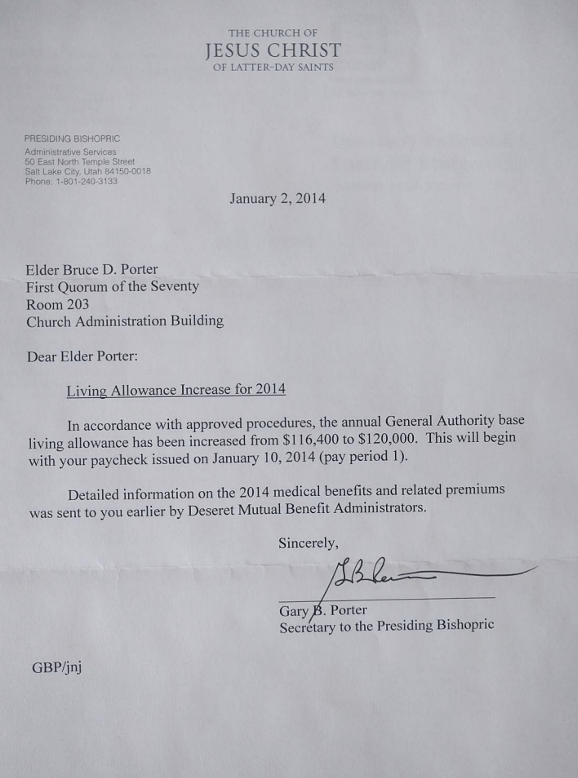
The document tells us that General Authorities, as of 2014, were paid $120,000 per year (not including travel reimbursements.)
This number is large. So large, in fact, that many members in a double income household do not make close to that amount. The average monthly expenses for American households total $6,440, according to the 2022 Consumer Expenditure Survey from the U.S. Bureau of Labor Statistics.[9] Yearly, that’s just about $77,000. $120,000 is very generous. That $120,000 also doesn’t include travel allowances or reimbursements, which would make up for a significant portion. It also does not account for the likely childless homes that the retired leaders occupy.
Perhaps the claim that there are “no paid clergy” can still remain. It’s not payment, in fact. It’s just a living stipend. A living stipend paid (though perhaps indirectly) by the tithing of members making far less.
It’s hard to picture the Savior of the world sitting atop such large hoards of money; and yet, this is what the leadership is forcing us to imagine, as they give such meager amounts to hungry children, and such vast amounts to themselves.
[1] David Beasley at the UN Food Systems Summit, 26 July 2021
[2] David Beasley at the UN Food Systems Summit, 26 July 2021
[3] Bob Rees, “The Incredible Power of Love and How it Can Save Lives: The Bob Rees Story,” Podcast released 2023
[4] Boyd K. Packer, “Follow the Brethren,” Ensign, Sept. 1979
[5] Preach My Gospel, 2004, p. 87
[6] Thomas S. Monson, “Our Sacred Priesthood Trust,” General Conference, May 2006
[7] Dallin H. Oaks, “Sacrifice,” General Conference, April 2012
[8] Gordon B. Hinckley, “Questions and Answers,” General Conference, Oct. 1985
[9] U.S. Bureau of Labor Statistics, 2022 Consumer Expenditure Surveys
