My discovery of Joseph’s history as a cunning treasure digger did not happen until my early adulthood. This was not for lack of research. As I’ve said, I was a studier.
Josephs arrests, conviction, and the witness accounts of his deception have been hidden. His treasure digging was no small part of his history. It was most of his early life. It was most of his father’s life, too. Still, covering up this dark stain on the Prophet’s life was a primary duty for Church leaders throughout most of the 20th century.
Latter-Day historian, Dean Jessee denied Joseph’s practice of treasure digging in the September 1979 Ensign:
“…following the organization of the Church in 1830, ‘many false reports, lies, and foolish stories, were published in the newspapers, and circulated in every direction…Among the earliest descriptions of Joseph were those published by Abner Cole…[who]sought to defame Joseph Smith and his work. He described the Prophet in degrading terms and explained the Book of Mormon as a deception growing out of the family’s use of ‘peep stones’ to dig for hidden treasure guarded by evil spirits…Cole laid the groundwork for the theme of deception, indolence, and irreligion that was to characterize descriptions of Joseph Smith in subsequent non-Mormon writings.’”[1]
Hugh Nibley, in his denouncement of Fawn Brodie, wrongfully denied Joseph’s magical past.
“We would applaud such strong-mindedness were it not that on the very next page she accepts the stories of the same witnesses regarding ‘seer stones, ghosts, magic incantations, and nocturnal excavations.’” [2]
Did the Church correct Nibley? Did they condemn his false reporting of history?
No.
He was praised, lauded, and given appointment to high status in the Church. In a letter to Nibley regarding his recently published ad hominem, David O. McKay shouted his gratitude.
“”Your comments disclose clearly not only [Brodie’s] immature, prejudiced thinking, but also the superficiality of the critics who have referred to her book as ‘scholarly’… You do yourself credit, and the Church honor!” [3]
Today, as knowledge of Joseph’s past has spread, Church leaders have been forced to admit the truth. In 2015, the Church published this statement, acknowledging Joseph’s use of the seer stone to dig for buried treasure.
“’Seeing’ and ‘seers’ were part of the culture in which Joseph Smith grew up. Some people in the early 19th century believed it was possible for gifted individuals to see lost objects by means of material objects such as stones. Joseph Smith and his family, like many around them, accepted these familiar folk practices.
In the 1820s, a fascination with purported Spanish treasure deposits led prospectors like Josiah Stowell to enlist the aid of seers like Joseph in their search for treasure.” [4]
The truth was hidden until it no longer could be.
The Covering Up of Joseph’s Use of the Seer Stone
For most of the Church’s recent history, faithful members will picture the Book of Mormon translation happening in the following way: Joseph Smith, sitting at a table with the Gold Plates in front of him; a scribe sitting across from him, separated by a cloth; Joseph reading each word, perhaps tracing his finger along the ancient Nephite characters.
This is the image the Church would like you to picture.
This image is not an accurate portrayal of history.
Of the translation process, David Whitmer, one of the Three Witness of the Book of Mormon said:
“Joseph Smith would put the seer stone into a hat, and put his face in the hat, drawing it closely around his face to exclude the light; and in the darkness the spiritual light would shine. Thus the Book of Mormon was translated by the gift and power of God, and not by any power of man.” [5]
Emma Smith spoke of a similar process.
“[Joseph sat] with his face buried in his hat, with the stone in it, and dictating hour after hour with nothing between us.” [6]
Martin Harris explained the exact method in which the seer stone would aid Joseph in translation.
“By aid of the Seer Stone, sentences would appear and were read by the Prophet and written by Martin, and when finished he would say “written,” and if correctly written, that sentence would disappear and another appear in its place, but if not written correctly it remained until corrected, so that the translation was just as it was engraved on the plates, precisely in the language then used.” [7]
I am not attempting to say that there was never a single mention of this method given by any leader with any authority. Rather, I am attempting to say that there never was a denial of the method presented in the artwork and widespread literature of the Church. There was never an outright, no-question admittance to the actual process. In nearly every case, if the seer stone was mentioned, it was mentioned in a recessed corner of some Ensign or New Era somewhere; and always, it was surrounded by faith-promoting retellings of history in which Joseph is portrayed to have translated in the manner which
Church leaders prefer: with his finger on the plates, hat nowhere to be found, dictating to his scribe.
Church leaders have gone to great lengths to preserve their version of history. Theirs is more palatable. An investigating member would rather not see the restoring Prophet with his face in a hat, peering at a magic stone.
This is the image I was shown hundreds of times as a young Latter-day Saint.
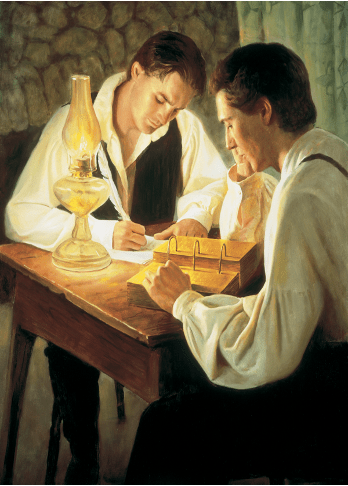
This image is a lie. It was plastered over magazine covers, shown in church manuals, and taught in conversion lessons. But the image portrayed never happened. Until my early adulthood, I was never shown this image:

The illustrations of Joseph Smith’s translation are not the only things done to cover up the actual history.
Joseph Fielding Smith denied the use of the seer stone in the translation of the Book of Mormon.
“While the statement has been made by some writers that the Prophet Joseph Smith used a seer stone part of the time in his translating of the record, and information points to the fact that he did have in his possession such a stone, yet there is no authentic statement in the history of the Church which states that the use of such a stone was made in that translation. The information is all hearsay, and personally, I do not believe that this stone was used for this purpose.″ [8]
Bruce R. McKonkie decried the use of seer stones, calling them “devilish.” He forgot to mention Joseph’s repeated use of such stone.
“In imitation of the true order of heaven whereby seers receive revelations from God through a Urim and Thummim, the devil gives his own revelations to some of his followers through peep stones, or crystal balls. An instance of this copying of the true order occurred in the early days of this dispensation. Hiram Page had such a stone and was professing to have revelations for the up-building of Zion and the governing of the Church.” [9]
These statements are dishonest. They were made to abscond the truth, to control the beliefs of the members of the Church. These statements were made by some of the highest appointed of God’s anointed. God’s chosen leaders. Liars and frauds. What, then, does that make God?
[1] Dean Jessee, “Among Historians,” Ensign, Sep. 1979
[2] Hugh Nibley, No, Ma’am, That’s Not History, 1946
[3] David O. Mckay, letter to Hugh Nibley, 16 May 1946
[4] Richard E. Turley Jr., Assistant Church Historian and Recorder, Robin S. Jensen and Mark Ashurst-McGee, Church History Department, “Joseph the Seer,” Ensign, Oct. 2015; Also published in the Church’s Gospel Topics manual, subtitled “Treasure Seeking.”
[5] David Whitmer, An Address to All Believers in Christ, 1887, p. 12
[6] Last Testimony of Sister Emma,” Saints’ Herald 26 (Oct. 1, 1879), 289–90
[7] Martin Harris, in an address to saints in Salt Lake City, 4 Sept. 1870, recorded and published by Andrew Jenson, “The Three Witnesses,” Historical Record 6 (May 1887):216-217
[8] Joseph Fielding Smith, Doctrines of Salvation, vol.3, p. 225-226
[9] Bruce R. McConkie, Mormon Doctrine, 2d ed., p.565
