Brigham Young’s ascendancy into leadership has very little evidence of being spiritually mandated. I mean that the history doesn’t really show that God had much of a hand in Young’s claiming of leadership.
This poses a problem for the LDS Church. What if Brigham Young was not the leader God chose to replace Joseph Smith? If that were the case, the current Church would be proven false. With this conundrum in place, the Church began to grasp away at some very large straws, hoping to find any evidence of God’s hand in Brigham’s ascendancy.
The Church took hold of what might have been the largest straw: they claimed that Brigham Young, during that conference in August of 1844 (when Sidney Rigdon was making his claim to the throne,) had been transfigured into the face, the voice, the very likeness of Joseph Smith. They claimed that all in attendance saw this manifestation, and thus offered a sustaining vote. How could they not? He changed before their very eyes.
“Thursday, 8 August 1844, stands as one of the most important days in the history of the Restoration. On that day a miracle occurred before the body of the Church—Brigham Young was transfigured before the people, and the succession crisis of the Church was resolved…While he was speaking, he was miraculously transfigured before the people.” [1]
It’s such a sensational event that it’s taught everywhere. I remember reading it in the “Picture Scriptures” as a child.
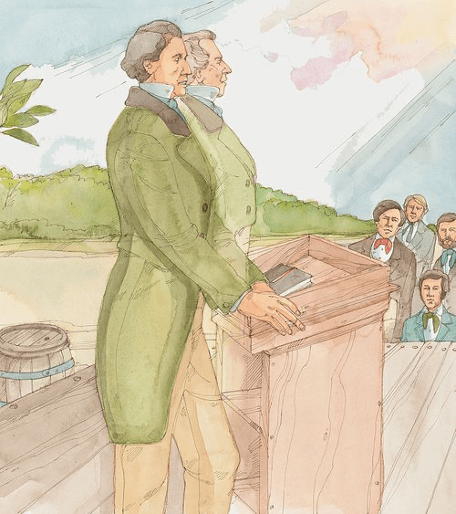
The Picture Scriptures tell the story in plain words.
“Then Brigham Young spoke and said the Apostles should lead the Church. The Holy Ghost was with him. Brigham Young’s voice sounded like Joseph Smith’s voice, and to some people he even looked like Joseph Smith. The Saints knew that God had chosen the Apostles to lead the Church, and they all voted to accept the Apostles as their leaders. Sidney Rigdon was angry. He went back to his home and started a church of his own. He was no longer a member of The Church of Jesus Christ of Latter-day Saints.” [2]
There is a problem with this story.
There was not a single contemporary account of the transfiguration. There was no journal entry, no newspaper clipping, no interview, no passing phrase to suggest that such a transfiguration had occurred. Brigham Young himself never mentioned the occurrence in his lifetime.
There are many retrospective tellings of the story (accounts written long after the occurrence.) This poses a few significant problems: many of the accounts differ in major ways from each other, and, some of the accounts were recorded by members who were not in attendance at all.
John D. Lee, adopted son of Brigham Young, wrote in his autobiography of the transfiguration, claiming to have seen Joseph in the countenance of Brigham Young.
“Sidney Rigdon was the first who appeared upon the stand. He had been considered rather in the back-ground for sometime previous to the death of the Prophet. He made but a weak claim. … Just then Brigham Young arose and roared like a young lion, imitating the style and voice of the Joseph, the Prophet. Many of the brethren declared that they saw the mantle of Joseph fall upon him. I myself, at the time, imagined that I saw and heard a strong resemblance to the Prophet in him, and felt that he was the man to lead us until Joseph’s legal successor should grow up to manhood, when he should surrender the Presidency to the man who held the birthright.” [3]
Unfortunately for the Church (and for Brigham Young,) John Lee was not in Nauvoo at the time of the event. His own journal entries do not have him returning to Nauvoo until two weeks after the occurrence. [4] John Lee recorded a false account of the transfiguration. Interestingly, Lee’s account of the transfiguration included a somewhat temporary support of Young as Prophet. Lee believed Young would hold the office for a time, and would later give it up to Joseph’s true heir.
Apostle Orson Hyde had a similar account of the transfiguration, almost 30 years after it happened:
“I heard the voice of Joseph through him, and it was as familiar to me as the voice of my wife, the voice of my child, or the voice of my father. And not only the voice of Joseph did I distinctly and unmistakably hear, but I saw the very gestures of his person, the very features of his countenance, and if I mistake not, the very size of his person appeared on the stand. And it went through me with the thrill of conviction that Brigham was the man to lead this people. And from that day to the present there has not been a query or a doubt upon my mind with regard to the divinity of his appointment; I know that he was the man selected of God to fill the position he now holds.” [5]
Except, he was not in attendance either. He’d been serving a mission in the Eastern states since April. He returned to Nauvoo five days after the conference. [6]
Wilford Woodruff also wrote of the event many years later:
“We met in a special conference, all the quorums, authorities, and members of the Church, that could assemble in Nauvoo. They were addressed by elder Brigham Young, the president of the quorum of the twelve. It was evident to the Saints that the mantle of Joseph had fallen upon him, the road that he pointed out could be seen so plainly, that none need err therein; the spirit of wisdom and counsel attended all his teachings, he struck upon a chord, with which all hearts beat in unison.” [7]
Except, he also was not in attendance. In his journal, on the same day of the miracle, he wrote, “the Twelve spent their time in the fore part of the day at the office and in the afternoon met at the grove.” [7] He didn’t watch the conference. He couldn’t have known of any transfiguration. In fact, Wilford Woodruff’s account of the entire day, a journal entry comprising over 2000 words, never mentions any miraculous transfiguration.
Every account of the transfiguration was made many years after it ostensibly occurred. The first time the account was ever discussed publicly was by apostle Albert Carrington in 1857 (thirteen years after the transfiguration.) He spoke to a large gathering of Saints in Salt Lake City, alongside Brigham Young. According to Young, Carrington spoke of Young’s transformation, claiming to have been unable to tell Young and the Prophet Joseph apart.
Young, in his discourse, uses Carrington’s testimony to prove a point—not, as some would hope, to prove that he did transform into the Prophet; rather, he referred to Carrington’s testimony to illustrate that men’s eyes are easily deceived.
“Brother Carrington’s testimony proves to you that men’s eyes are liable to be deceived. It may appear strange to some that he could not tell me from Joseph Smith, when I was speaking in the stand in Nauvoo during the October Conference of 1844. Somebody came along and passed a finger over his eyes and he could not see anyone but Joseph speaking, until I got through addressing the congregation.” [9]
The first time the transfiguration is ever mentioned publicly, Brigham is quick to deny it. He calls any chance of a transfigurement to be pure deception of the eyes; a mere mirage, a trick of the eye. Nothing resembling a miracle.
In 1870, as stories of the miracle were being widely fabricated, Sidney Rigdon wrote to Brother Brigham, condemning his lies and the inaccuracy of his storytelling.
“O vain man Brigham Young[,] Did you suppose that your hypocritical and lying pretence that the spirit of Joseph Smith had entered into you, was going to prevail with God and man. You knew you lied when you made that pretence. Your ignorance was such that you did not know that there were those living who knew that there never was, is, nor will be, such a metempsychosis on this earth as you wickedly and heaven daringly pretended had taken place with you. Those in former times who, assisted by the Devil, were attempting to establish idolatry made such pretentions to accomplish that object.” [10]
The 1844 Conference stands as one of the modern Church’s primary claims to authority. In a time when the line of authority was crooked and hazy, Brigham Young was transformed into the Prophet Joseph Smith. Not Sidney Rigdon. Yet, Sidney Rigdon denies the event ever taking place. Brigham Young denies the event taking place. The only evidence we have for the event ever having occurred are accounts written decades after the event by Saints who were not there.
Richard S. Van Wagoner, historian of the Latter-day Saint movement who took a special interest in Brigham Young’s metamorphosis, takes the same conclusion: the transfiguration was a lie, fabricated decades after it supposedly occurred. It never happened. No one saw it. No one experienced it.
“Apostles Brigham Young, Heber C. Kimball, Willard Richards, and Wilford Woodruff, all of whom made 8 August 1844 entries in their diaries, make no reference to an epiphany. Such an event, had it truly transpired, would have stood at the apogee of world history, a physical metamorphosis unsurpassed except for the transfiguration and resurrection of Jesus Christ. Yet neither the Times and Seasons nor the Nauvoo Neighbor, local newspapers owned by the church, mention such a wonder. Neither do the 1844 and 1845 accounts of Jedediah Grant and Orson Hyde, specifically written to refute Sidney Rigdon’s robust challenge to the Quorum of Twelve’s succession claims.” [11]
When I began researching this supposed miracle, I was confused by the timeline: Brigham Young was transfigured in August of 1844. But, he would not become the President of the Church until December of 1847. Three years later.
If the transfiguration did occur, it did not have spiritual significance enough for the members to appoint Brigham to Presidential office.
The Church claims that the transfiguration of Brigham Young ended the succession crisis—but it didn’t. The crisis continued for three years. Sidney Rigdon continued to strip followers from Young into his own religion. Members continued to rally in support of other leaders. The crisis was only beginning. Why, if Brigham was meant to be the Prophet, did word of the transfiguration hide in darkness for decades? Why, when the Church needed a leader, did God refuse to appoint one?
B. H. Roberts, after being criticized for omitting commonly perpetuated spiritual myths from The Comprehensive History of the Church, spoke against mythical tales in a religion which claims itself as true.
“Suppose your youth receive their impressions of church history from ‘pictures and stories’ and build their faith upon these alleged miracles [and] shall someday come face to face with the fact that their belief rests on falsehoods, what then will be the result? Will they not say that since these things are myth and our Church has permitted them to be perpetuated… might not the other fundamentals to the actual story of the Church, the things in which it had its origin, might they not all be lies and nothing but lies?” [12]
[1] Church History in the Fulness of Times Student Manual, “Chapter Twenty-Three: The Twelve to Bear Off the Kingdom,” p. 291
[2] Church of Jesus Christ of Latter-day Saints, “Scripture Stories: Doctrine and Covenants,” Chapter 58: A new leader for the Church: July-August 1844, 1983, republished in 2002.
[3] John D. Lee, Mormonism Unveiled; including the Remarkable Life and Confessions of th Late Mormon Bishop, John D. Lee, 1881, p. 155
[4] Journal of John D. Lee, May 1844 – Nov. 1846, p. 51
Lee’s mission in Kentucky terminated in August 1844. His diary includes a detailed description of his journey home, and specifically describes him as having returned home August 20th, 1844, twelve days after the supposed transfiguration.
“Aug. 20th. I reached home safe found all my effects in good order for which I close by offering a tribute of praise to Him that has guided me safely home in peace.
Tues 20th dis. of travel in this month by water 1000 miles by land over 100 miles.
August 20th 1844”
[5] Discourse by Elder Orson Hyde, delivered in the Temple, St. George, April 5, 1877. Reported by Geo. F. Gibbs. Recorded in the Journal of Discourses, Vol. 19, p 58
[6] Wilford Woodruff, Journal (January 1, 1843 – December 31, 1844), p. 310
The journal entry records Hyde’s homecoming. “13th Elder O. Hyde returned home to Nauvoo to day.”
[7] “To the [Church] Officers and Members,” in Latter-day Saints’ Millennial Star, Feb. 1845.
[8] Wilford Woodruff, Journal (January 1, 1843 – December 31, 1844), August 7, 1844 – August 8, 1844, p. 301
[9] Brigham Young, Journal of Discourses, Vol. 5:12, discourse given at the Bowery, Salt Lake City, July 19, 1857.
Also of note: Young’s and Carrington’s remarks regarding the transfiguration were so unimportant to the context of the meeting that they do not even make it into the minutes of the meeting, recorded by Leo Hawkins. The first time this event (which is so important to the authority claim of the current Church) is ever spoken aloud, it is not written down, as it was too obscure, too random, to be worth the ink.
[10] Sidney Rigdon letter to Brigham Young, 6 Dec. 1870, as contained in the Church History Library, Brigham Young Office Files, box 41 fd. 29.
Transcribed also in Sidney Rigdon’s Copying Book A & Book of the revelations of Jesus Christ to the children of Zion through Sidney Ridgon prophet& seer & revelator, sec. 61, pp. 97-8
[11] Richard S. Van. Wagoner, “The Making of a Mormon Myth: The 1844 Transfiguration of Brigham Young”
[12] Truman G. Madsen, Defender of the Faith: The B. H. Roberts Story, 1980, p. 363
